Learning Center
Explore helpful articles about buying a home, refinancing, home equity, and second mortgages.
Learn How to Borrow from Your Home's Equity

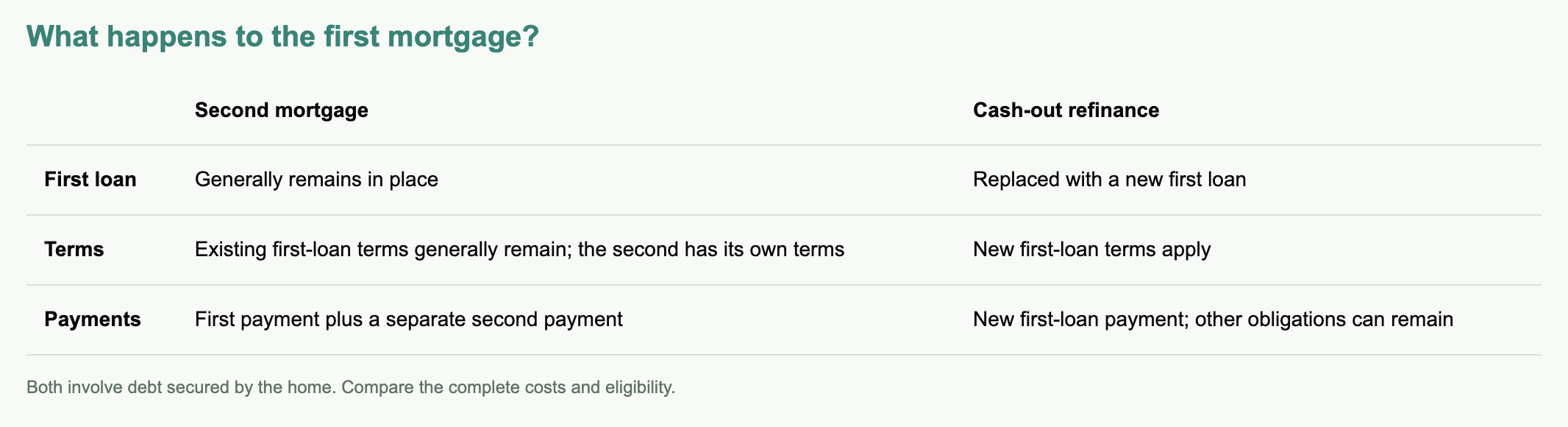
A second mortgage allows you to access cash by borrowing against your home's equity. There are two primary types of second mortgages: Home Equity Lines of Credit (HELOCs) and Home Equity Loans.
These are called second mortgages because they are additional loans secured by your home while you're still making payments on your first mortgage, which is the loan used to purchase or refinance your property. Second mortgages typically come with higher interest rates and stricter credit requirements compared to first mortgages. Additionally, you may be able to borrow less money through a second mortgage than through a cash-out refinance.
A cash-out refinance replaces your existing mortgage with a larger new loan. Cash available to you is the difference after closing costs, required payoffs, and other adjustments.
✅ A lump-sum second mortgage and a HELOC work differently. Watch this comparison of how funds are received, borrowing flexibility, and fixed versus variable rates. HELOC information is educational.
Why Do Second Mortgages Have Higher Interest Rates?
Second mortgages often have higher interest rates because they are subordinate to your first mortgage. In the event of a default, the lender of the first mortgage is repaid first from the sale of the home, and the lender of the second mortgage is repaid only if there are remaining funds.
Lien priority can influence pricing, eligibility, and borrowing limits, but the exact requirements depend on the program. Approval for one product does not guarantee approval for another.
How Do Second Mortgages Work?
Second mortgages operate similarly to other types of home loans. You will need to fill out an application, submit financial documents, meet credit and income requirements, and pay closing costs.
The lender may require an appraisal or another permitted valuation method. Borrowing capacity also depends on combined loan-to-value (CLTV): all relevant loan balances secured by the home divided by its accepted value. For example, a $300,000 first mortgage plus a $75,000 second mortgage on a $500,000 home equals 75% CLTV. This is an arithmetic illustration, not a loan offer.
Explore eCash Mortgage’s fixed-rate second mortgage options. eCash Mortgage does not offer HELOCs.
What Can You Do with Cash from a Second Mortgage?
Funds may be used for eligible expenses such as home improvements, education, business needs, or paying off other debts. Uses and restrictions depend on the loan program. You must repay the second mortgage in addition to your first mortgage. Failure to repay a loan secured by your home can lead to foreclosure, and debt consolidation may increase total interest if repayment is stretched over a longer term.
Review the benefits and risks of using home equity for debt consolidation.