Learning Center
Explore helpful articles about buying a home, refinancing, home equity, and second mortgages.
Learn One Way You Can Change Your Monthly Mortgage Payment

A mortgage recast occurs when you make a large one-time payment to reduce your mortgage balance, prompting your lender to recalculate your monthly payment accordingly. This process, also known as a re-amortization of your loan, allows your lender to restructure your monthly payment schedule for the remainder of your loan term based on the lump-sum payment.
While a mortgage recast does not alter your interest rate or loan terms, it can lower your required minimum monthly payment and may save you money on interest over the life of the loan.
Not all lenders offer recasting, and not all loan types are eligible. You can still make a lump-sum payment to decrease your principal balance, but without a recast, your monthly mortgage payment would remain unchanged.
Mortgage Recast Example:
When considering whether to recast your mortgage, it's often helpful to look at the numbers to determine if it's worthwhile. Here's an example:
- Illustrative current mortgage balance: $282,000
- Remaining loan term: unchanged by the recast
- Lump Sum Payment: $50,000
- Remaining Amount: $232,000
In this scenario, the borrower may be able to request their lender to recast the mortgage, resulting in a new, lower monthly payment for principal and interest.
Is It a Good Idea to Recast Your Mortgage?
Recasting your mortgage has both advantages and disadvantages. By making a large lump-sum payment, typically required for mortgage recasting, you can lower your monthly payment and potentially save on interest payments. However, making such a payment means you won't have that cash available for emergencies or other expenses.
Alternatively, you might consider making a lump-sum payment to reduce your principal balance without recasting your mortgage, thereby keeping your monthly payment the same. The advantage here is that this strategy may allow you to pay off your mortgage faster, potentially saving you more in interest over the life of the loan.
Should You Refinance or Recast Your Mortgage?
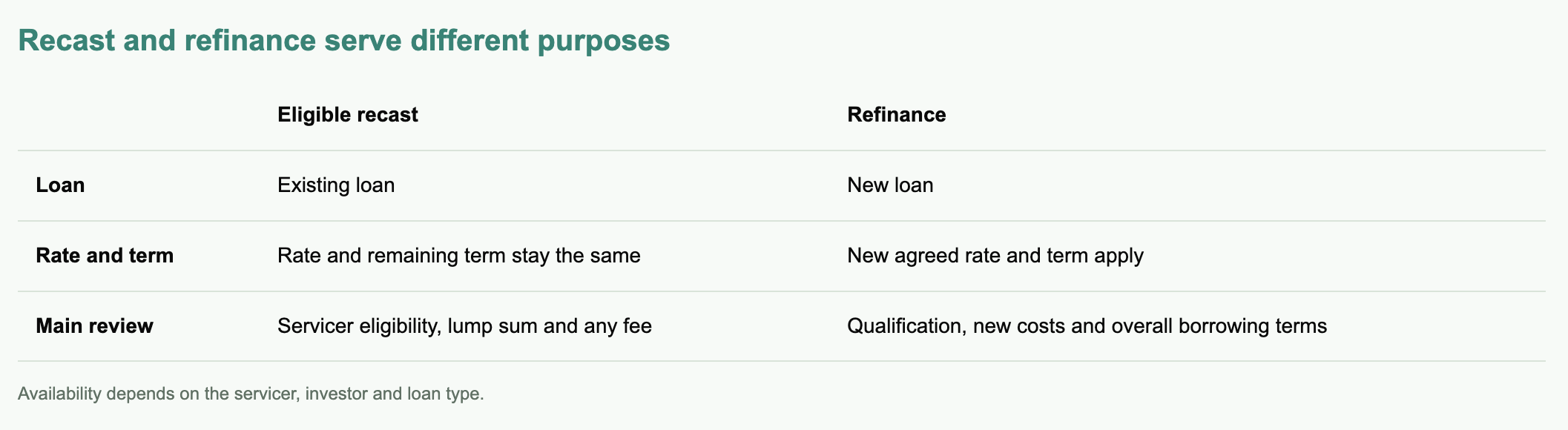
Both recasting and refinancing can help lower your monthly payment and save on interest. However, recasting requires a substantial cash payment and does not allow you to change your interest rate or other loan terms.
In contrast, refinancing gives you the opportunity to lower your interest rate and potentially reduce your payment or save on interest. Refinancing does not require a large upfront cash payment, although you will likely incur closing costs, and you'll need to meet your lender's credit, income, and financial requirements for approval.
Consider both options carefully to determine which is the right choice for you. Keep in mind that refinancing can lead to higher total finance charges over the life of the loan.
How Often Can You Recast Your Mortgage?
Recast availability, minimum principal payments, fees, and frequency limits depend on your servicer, investor, and loan type. Ask for the current requirements before sending a lump sum. Some loans are not eligible. If you choose to pay extra principal without recasting, confirm how your servicer applies the payment.